
Tel: 0086-532-88966982
0086-532-88965892
Website: www.lidajituan.com
E-mail: sales@lidajituan.com
Head office: 5th Floor, Building A, Darron Center, 180 Haier Road, Qingdao, 266000, China
Prefab vs. Traditional Construction: Why Mining Companies Choose Flat Pack Containers
Classification:Industry News
Release time:2025-05-19 00:00
Prefab vs. Traditional Construction: Why Mining Companies Choose Flat Pack Containers
The mining industry operates in some of the world’s most remote and challenging environments, where speed, durability, and cost-efficiency are non-negotiable. For decades, traditional construction methods—brick, mortar, and steel frameworks—were the default for building on-site offices, housing, and storage facilities. However, the rise of flat pack container solutions is reshaping the industry’s approach to infrastructure. Companies like Lida Group, pioneers in container building and modular house technology, are driving this shift, offering mining firms a smarter way to balance productivity, sustainability, and worker welfare. This article explores why prefab container systems are outpacing traditional construction in mining, backed by real-world benefits and innovations.
1. The Mining Industry’s Infrastructure Challenges
Mining projects face unique hurdles when building on-site facilities:
- Remote Locations: Sites are often hundreds of miles from urban centers, complicating material transport.
- Harsh Conditions: Extreme temperatures, dust storms, and seismic activity demand rugged structures.
- Fluctuating Workforce: Temporary projects require scalable housing that can expand or contract as needed.
- Budget Pressures: High upfront costs for traditional buildings strain tight budgets.
Traditional construction struggles to address these issues, leading to delays, cost overruns, and subpar living conditions for workers. Enter flat pack containers—a prefab alternative that’s faster, cheaper, and more adaptable.
2. What Are Flat Pack Containers?
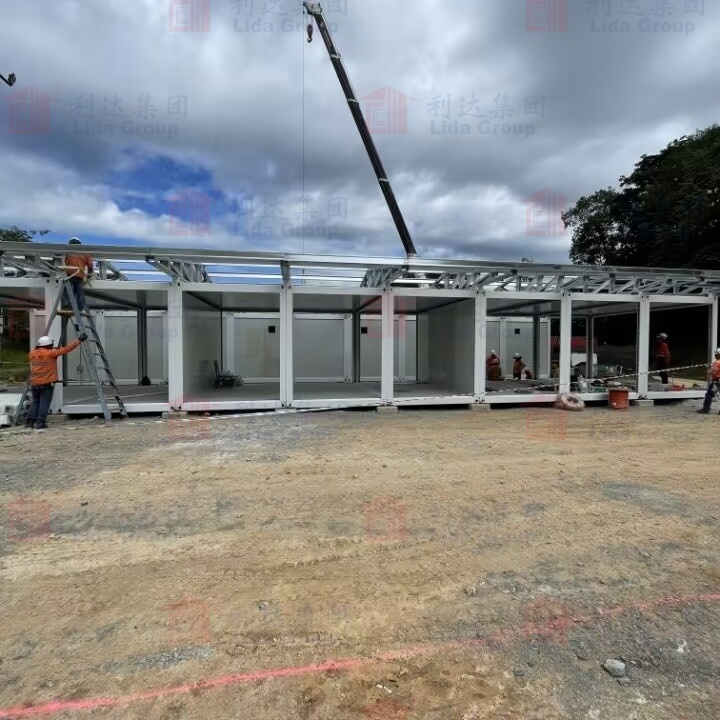
Flat pack containers are prefabricated modular structures designed for easy transport and rapid assembly. Unlike pre-assembled container houses, these units are disassembled (“flat packed”) during shipping, reducing logistical costs and space requirements. Once on-site, they can be quickly reconstructed into offices, dormitories, labs, or equipment storage.
Lida Group’s flat pack systems, for example, use standardized components like wall panels, roofing, and flooring that snap together with minimal tools. This plug-and-play approach is ideal for mining camps in regions like the Australian Outback or Chilean Andes, where speed and simplicity are critical.
3. Cost Efficiency: Slashing Expenses Without Sacrificing Quality
Mining companies are under constant pressure to optimize budgets. Here’s how flat pack containers deliver superior cost savings:
- Lower Material Costs: Repurposed shipping containers cut steel and concrete expenses by 30–50%.
- Reduced Labor Costs: Up to 80% of construction is completed in factories, minimizing on-site labor.
- Reusable Designs: Containers can be disassembled and reused across multiple projects, avoiding rebuild costs.
A 2023 study by Lida Group found that mining companies using their flat pack systems saved an average of $150,000 per 20-unit camp compared to traditional builds. These savings can be redirected toward safety upgrades, exploration, or community development initiatives.
4. Speed: From Months to Weeks
In mining, time lost equals revenue lost. Traditional construction can take 6–12 months to complete a camp, while flat pack containers slash timelines dramatically:
- Factory Precision: Units are pre-engineered with electrical, plumbing, and HVAC systems installed off-site.
- Rapid Assembly: A 50-unit camp can be operational in 4–6 weeks versus 8–12 months for traditional builds.
- Weather Resilience: Indoor manufacturing avoids rain, snow, or heat delays common in on-site construction.
For example, during a gold mine expansion in Ghana, Lida Group deployed 30 flat pack dormitories and office container units in just 25 days—keeping the project on schedule despite monsoon disruptions.
5. Durability: Built to Endure the Toughest Conditions
Mining sites demand structures that can withstand corrosion, heavy vibrations, and extreme weather. Flat pack containers excel here:
- Corten Steel Frames: Naturally resistant to rust, fire, and impacts.
- Reinforced Insulation: Triple-layered walls maintain temperatures in -40°C to 50°C environments.
- Modular Flexibility: Damaged sections can be replaced individually without dismantling the entire structure.
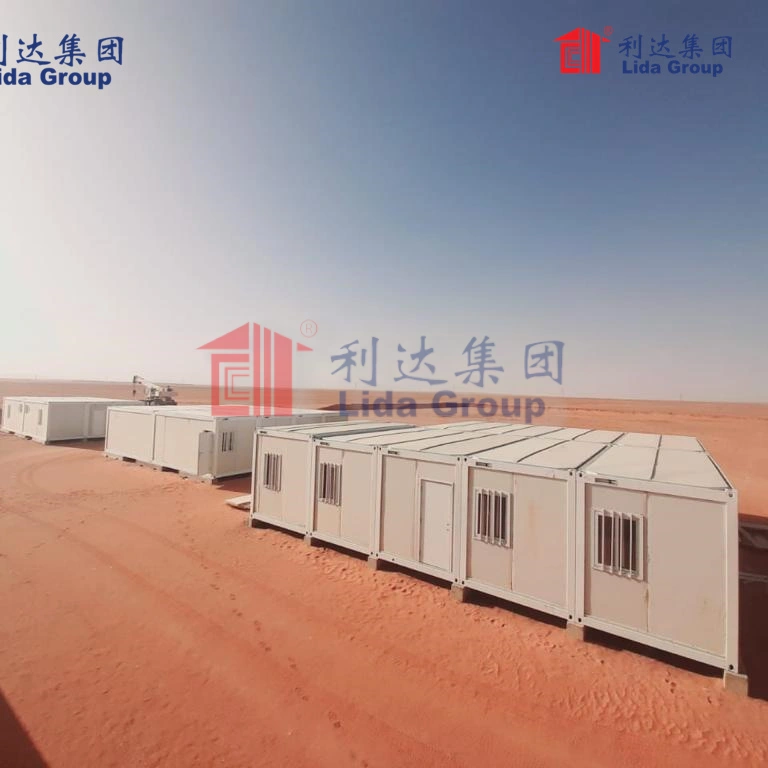
Lida Group’s mining-specific designs include seismic bracing, dust-proof ventilation, and explosion-proof electrical systems, ensuring compliance with industry safety standards.
6. Sustainability: Aligning with ESG Goals
As mining companies face stricter environmental regulations and investor demands, flat pack containers offer eco-friendly advantages:
- Recycled Materials: Each repurposed container saves 3,000 kg of steel from landfills.
- Energy Efficiency: Solar panels and LED lighting reduce reliance on diesel generators.
- Low Waste: Precision manufacturing cuts material excess by 60% compared to traditional methods.
In 2022, a copper mine in Zambia partnered with Lida Group to build a solar-powered modular house camp, achieving a 40% reduction in carbon emissions and earning accolades for sustainable innovation.
7. Scalability: Grow (or Shrink) with Project Needs
Mining projects often scale up during exploration phases and wind down during maintenance. Flat pack containers provide unmatched flexibility:
- Expandable Designs: Add expandable container house units to double living space during workforce peaks.
- Reconfigurable Layouts: Convert storage units into offices or medical clinics as needs evolve.
- Easy Relocation: Disassemble and move units to new sites, avoiding redundant construction.
A silver mine in Mexico used Lida Group’s hybrid system—combining office container workspaces with expandable housing—to adjust camp capacity monthly, saving $200,000 annually in construction costs.
8. Case Study: Lida Group’s Iron Ore Camp in Western Australia
Challenge: A mining giant needed to house 500 workers in the Pilbara region, where summer temperatures exceed 45°C and cyclones are frequent. Traditional builds were deemed too slow and vulnerable.
Solution:
- 250 Flat Pack Units: Including dormitories, offices, and a recreation center.
- Heat-Resistant Materials: Reflective roofing and advanced cooling systems.
- Cyclone-Proof Anchoring: Engineered to withstand 150 mph winds.
Results:
- 70% Faster Deployment: Camp operational in 10 weeks.
- Zero Safety Incidents: Despite extreme conditions.
- 30% Cost Savings: Versus initial traditional construction quotes.
This project solidified flat pack containers as the gold standard for remote mining camps.
9. Worker Welfare: Boosting Morale in Remote Locations
Happy workers are productive workers. Flat pack containers can be customized to improve quality of life:
- Modern Amenities: Air conditioning, ergonomic furniture, and high-speed internet.
- Recreation Spaces: Gyms, cinemas, and even wedding container house venues for special events.
- Aesthetic Upgrades: Wood-effect paneling, green walls, and ample natural light combat the “industrial” feel.
Lida Group’s mining camps in Canada feature rooftop gardens and communal kitchens, fostering camaraderie and reducing staff turnover.
10. The Future of Mining Infrastructure
Innovations in container building are pushing boundaries further:
- Smart Containers: IoT sensors monitor air quality, energy use, and structural integrity.
- 3D-Printed Add-Ons: Custom interiors printed on-site for rapid personalization.
- Hybrid Energy Systems: Combining solar, wind, and hydrogen power for off-grid resilience.
Lida Group is piloting AI-driven camps in Chile, where self-regulating temperatures and predictive maintenance algorithms optimize efficiency.
Conclusion: Why Flat Pack Containers Are Mining’s New Foundation
The choice between prefab and traditional construction is no longer a debate for forward-thinking mining companies. Flat pack containers deliver unmatched cost savings, speed, durability, and scalability—all while supporting sustainability and worker well-being.
By partnering with innovators like Lida Group, the mining industry is proving that “temporary” doesn’t have to mean “compromise.” From rugged office container hubs in the Sahara to relocatable modular house camps in the Rockies, flat pack technology is building the future of mining, one container at a time.
office container,modular house,constructions,prefab house
Contact Us
Head Office: 5th Floor,Building A,Darron Center,No.180,Haier Road,Qingdao, 266000,China
Tel: 0086-532-88966982 88965892 Fax:0086-532-88965571
WhatsApp:+86 13793209022
Mobile/Wechat:+86-15166671720
Email: sales@lidajituan.com Website: www.lidajituan.com
Alternate Website: www.lidamodularhouse.com

Head Office: 5th Floor,Building A,Darron Center,No.180,Haier
Road,Qingdao, 266000,China
Tel: 0086-532-88966982 88965892
Fax:0086-532-88965571
Email: sales@lidajituan.com
Website: www.lidajituan.com
Wechat/WhatsApp:+86-13793209022
Copyright(c)2023 All Rights Reserved SEO Business license