
Tel: 0086-532-88966982
0086-532-88965892
Website: www.lidajituan.com
E-mail: sales@lidajituan.com
Head office: 5th Floor, Building A, Darron Center, 180 Haier Road, Qingdao, 266000, China
Maximizing Mining Efficiency: How Prefab Steel Structures Revolutionize Energy Sector Builds
Classification:Company News
Release time:2025-04-16 07:00
Maximizing Mining Efficiency: How Prefab Steel Structures Revolutionize Energy Sector Builds
The mining industry stands at a crossroads. With global demand for critical minerals surging—driven by renewable energy technologies, EV batteries, and infrastructure expansion—operators face unprecedented pressure to scale production while slashing costs and environmental footprints. Traditional construction methods, plagued by slow timelines, exorbitant budgets, and inflexible designs, are ill-suited to meet these challenges. Enter prefabricated steel structures, a game-changing approach that is reshaping mining camps, processing plants, and energy sector infrastructure. Companies like Lida Group, a pioneer in modular and steel structure building solutions, are leading this transformation by merging engineering ingenuity with the urgent needs of modern mining and energy projects.
At the heart of this shift is the recognition that mining efficiency isn’t just about extraction rates or ore grades—it’s about the speed and adaptability of supporting infrastructure. Prefab steel structures, encompassing both light steel structures for temporary facilities and heavy steel structures for permanent installations, offer unmatched advantages. Consider a typical open-pit mining operation: it requires workshops for equipment maintenance, warehouses for spare parts, processing plants, and worker accommodations, often in remote, geologically unstable regions. Traditional concrete-based construction in such environments can take years, with costs ballooning due to logistical hurdles. In contrast, Lida Group’s prefab steel structures for a copper mine in Zambia reduced initial build time by 60%, with modular workshops and warehouses assembled on-site in under four months. This acceleration enabled the mine to commence production 10 months ahead of schedule, unlocking $220 million in early revenue.
The secret lies in off-site fabrication. Up to 90% of a steel structure building—from wall panels to roof trusses—is manufactured in controlled factory settings, then shipped to the project site for rapid assembly. This method minimizes weather delays, a critical factor in regions like Canada’s oil sands or Chile’s Atacama Desert, where temperature extremes and storms disrupt conventional builds. For example, Lida Group’s modular house units for a gold mining camp in Siberia were constructed in their Shanghai facility, transported via rail, and installed within weeks, bypassing -50°C winter conditions that would have frozen concrete pours. The table below illustrates the stark contrast between traditional and prefab approaches in mining construction:
But the benefits extend beyond speed. Prefab steel structures are inherently customizable, a vital trait for energy sector projects where facilities must adapt to evolving technologies. Take lithium processing plants: as extraction methods shift from hard-rock mining to brine-based techniques, infrastructure needs change. Lida Group addressed this for a Bolivian lithium project by designing modular processing workshops with interchangeable heavy steel structure frames. When the client pivoted to direct lithium extraction (DLE) technology midway, the plant’s layout was reconfigured in weeks by rearranging prefab modules—a feat impossible with fixed concrete structures. Similarly, in the oil & gas sector, prefab steel warehouses storing drilling equipment can be disassembled and relocated as exploration sites shift, avoiding the “stranded asset” dilemma.
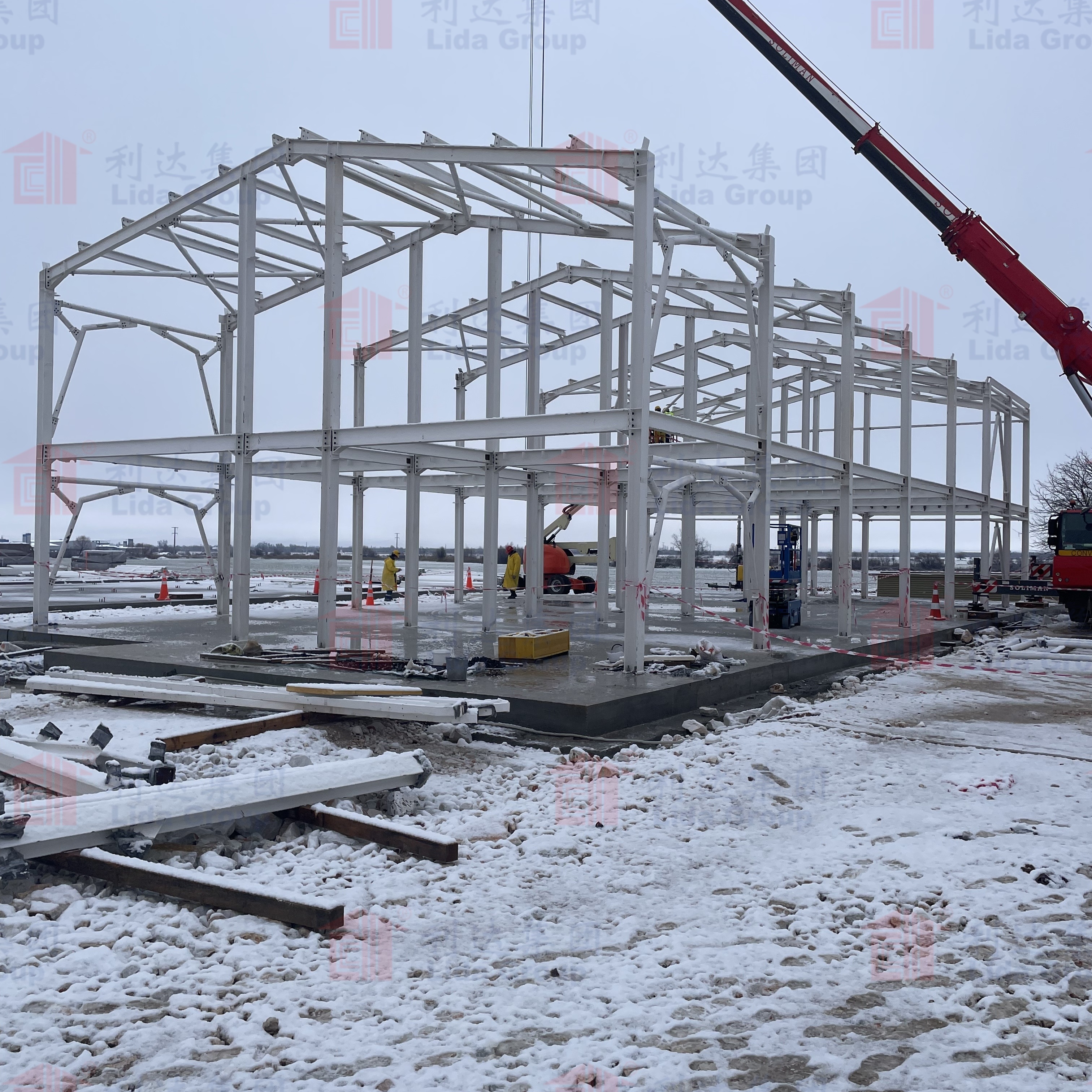
Durability is another cornerstone. Mining and energy sites expose structures to corrosive chemicals, abrasive dust, and seismic activity. Heavy steel structures, with their thick, hot-rolled beams and advanced coatings, withstand these assaults far better than concrete. Lida Group’s work in Indonesia’s Grasberg mine, one of the world’s most seismically active regions, showcases this. Their prefab processing plant used steel moment frames capable of absorbing 8.0-magnitude earthquake forces, while galvanized coatings resisted sulfur dioxide emissions from copper smelting. Five years post-construction, the facility reports zero structural degradation—compared to adjacent concrete buildings requiring annual repairs.
Energy efficiency, increasingly mandated by ESG standards, is another arena where prefab steel structures excel. Insulated sandwich panels, a staple of modular house designs, cut heating and cooling loads by up to 50% in mining camps. Lida Group’s “EcoCamp” solution for a Canadian diamond mine integrated solar-ready steel roofs with triple-glazed windows, reducing diesel generator use by 70%. For processing plants, their steel structure building designs incorporate natural ventilation stacks and heat recovery systems, slashing energy consumption. A platinum refinery in South Africa achieved a 35% reduction in operational carbon emissions after switching to Lida’s prefab steel workshop with integrated solar cladding.
Cost predictability, often elusive in mining projects, is another advantage. Prefab steel structures operate on fixed-price contracts, with most risks (material waste, labor shortages) absorbed during factory production. In Mongolia’s Oyu Tolgoi copper-gold mine, budget overruns plagued initial concrete-based builds, exceeding estimates by 200%. When Lida Group took over the construction of a new concentrator workshop using heavy steel structures, the project stayed within 5% of its $85 million budget, thanks to precise BIM-driven material ordering and robotic welding that minimized errors.
The integration of smart technologies further elevates prefab steel’s value. IoT-enabled sensors embedded in steel beams allow real-time monitoring of structural health—critical for offshore oil platforms or mines prone to subsidence. At Lida Group’s bauxite mining workshop in Guinea, strain gauges detect micro-deformations in steel frames, triggering maintenance alerts before failures occur. Similarly, their modular house units for energy sector workers in Texas feature smart climate control systems that adjust energy use based on occupancy, cutting utility costs by 40%.
Looking ahead, the convergence of AI and prefab steel promises even greater leaps. Generative design algorithms can now optimize steel structures for specific mining terrains, minimizing material use while maximizing load capacity. Lida Group’s AI platform, tested in a Chilean iron ore project, reduced steel tonnage in a conveyor support structure by 22% without compromising strength. Robotics, too, are reshaping fabrication: their Tianjin factory deploys autonomous welding arms that assemble light steel structure modules with 0.1mm precision, eliminating human error.
Yet challenges persist. Transporting heavy steel components to ultra-remote sites remains logistically complex. Lida Group’s solution? A partnership with drone manufacturers to 3D-map delivery routes and prefab modular units into smaller, helicopter-transportable kits. In Papua New Guinea’s Frieda River mine, this approach enabled the airlift of a 1,200-ton steel workshop to a roadless mountain site, cutting delivery time from 18 months to six.
The energy sector’s green transition is also reshaping demands. Hydrogen production facilities, carbon capture plants, and battery recycling hubs require steel structures that adapt to emerging processes. Lida Group’s prototype “FuturePlant” design uses modular heavy steel frames with interchangeable process modules, allowing mines to pivot from coal to rare earth processing without rebuilding infrastructure. In Norway, their prefab hydrogen storage warehouse for an offshore wind project features explosion-resistant steel panels and leak-detection systems, illustrating the versatility of steel in the low-carbon era.
In essence, prefab steel structures are not just buildings—they’re strategic tools for maximizing mining efficiency and enabling the energy transition. By embracing the speed, durability, and adaptability of companies like Lida Group, the mining and energy sectors can build smarter, faster, and greener, turning infrastructural constraints into competitive advantages. As one project manager at a Zambian cobalt mine remarked after switching to prefab steel, “We’re not just constructing a workshop; we’re engineering time itself.”
light steel structure,lida group,ware house,mining,constructions
Contact Us
Head Office: 5th Floor,Building A,Darron Center,No.180,Haier Road,Qingdao, 266000,China
Tel: 0086-532-88966982 88965892 Fax:0086-532-88965571
WhatsApp:+86 13793209022
Mobile/Wechat:+86-15166671720
Email: sales@lidajituan.com Website: www.lidajituan.com
Alternate Website: www.lidamodularhouse.com

Head Office: 5th Floor,Building A,Darron Center,No.180,Haier
Road,Qingdao, 266000,China
Tel: 0086-532-88966982 88965892
Fax:0086-532-88965571
Email: sales@lidajituan.com
Website: www.lidajituan.com
Wechat/WhatsApp:+86-13793209022
Copyright(c)2023 All Rights Reserved SEO Business license