
Tel: 0086-532-88966982
0086-532-88965892
Website: www.lidajituan.com
E-mail: sales@lidajituan.com
Head office: 5th Floor, Building A, Darron Center, 180 Haier Road, Qingdao, 266000, China
Camp House Engineering Breakthroughs: Lida Group's Durable Light Steel Structure Designs for Remote Sites
Classification:Industry News
Release time:2025-11-25 09:58
Camp House Engineering Breakthroughs: Lida Group's Durable Light Steel Structure Designs for Remote Sites
The howling winds of Siberia's Udachny diamond mine rip across the tundra at -52°C, cold enough to freeze hydraulic fluid into sludge and turn conventional steel brittle as glass. Here, where traditional mining camps collapse under thermal stress, Lida Group's engineered camp house complex stands defiant – maintaining habitable conditions while neighboring structures succumb to polar brutality. This resilience embodies decades of Arctic engineering distilled into purpose-built light steel structure solutions that transform remote operations from logistical gambles into sustainable enterprises. As nations race to secure critical minerals beneath thawing permafrost, these durable designs become strategic imperatives for resource industries pushing into Earth's most challenging environments.
Remote site operations face compounding assaults that dismantle traditional constructions. Standard steel fractures catastrophically below -45°C under load, while thermal bridging siphons heat through structural members creating ice-lined interiors despite roaring heaters. Permafrost degradation beneath foundations causes differential settlement measured in centimeters monthly, and corrosive dust penetrates electrical systems triggering failures. The logistical impossibility of three-month construction windows before winter lockdown compounds these challenges, often leaving projects stranded without adequate accommodations for workers. Lida Group's Arctic-grade steel structure buildings conquer these threats through revolutionary material science and precision manufacturing that redefine durability in extreme environments.
The engineering begins with metallurgical innovation. Nickel-enriched S355J2W steel maintains Charpy V-notch impact resistance above 100J at -60°C – verified through cryogenic testing simulating decades of polar winters. Cryogenic welding protocols control hydrogen diffusion to prevent cold cracking in joints, while slotted connection systems accommodate thermal contraction without stress fractures. Composite wall systems integrate aerogel-enhanced panels achieving R-50 values within 200mm profiles, creating thermal breaks that reduce heat loss by 63% compared to conventional builds. Triple-glazed windows with suspended low-e films and krypton gas fills achieve U-values of 0.62 W/m²K, while magnetic gasket systems create hermetic seals against wind-driven snow infiltration that would compromise lesser structures.
Manufacturing precision ensures field reliability impossible with site construction. Robotic welding in climate-controlled facilities achieves 0.1mm tolerances unattainable in Arctic winds, creating components with 99.97% interchangeability across global projects. CNC machines cut connection plates with laser-guided accuracy, while automated coating systems apply uniform corrosion protection resistant to chemical exposure. This controlled environment eliminates weather delays and quality variations that plague site-built alternatives, reducing defects by 92% while compressing production timelines. For remote locations, this manufacturing discipline proves critical when replacement parts require months-long logistics chains across frozen terrain where mistakes cannot be easily corrected.
Exploration camp mobility solutions demonstrate innovative adaptation. Helicopter-transportable 20ft modular house units with boltless screw foundations install in 90 minutes, establishing functional bases in roadless locations within eight hours. These compact units feature integrated solar/wind hybrid power packages and water recycling systems enabling operation without external infrastructure. For temporary mining camps, this mobility allows teams to advance with exploration activities rather than being constrained by fixed facilities, significantly accelerating resource identification and development timelines in remote regions where every day of operation counts against seasonal windows.
Permanent camp house complexes incorporate sophisticated engineering for long-term habitability. Vibration-damped floors isolate sleeping quarters from generator noise and equipment harmonics, while positive-pressure ventilation systems maintain ISO Class 8 air cleanliness excluding abrasive dust from living spaces. Hydronic heating systems with redundant boilers ensure thermal comfort even during extreme cold events, with backup power systems maintaining operation during primary power failures. These features reduce medical evacuations by 47% at Arctic operations compared to conventional camps, directly impacting productivity during critical exploration and production windows where skilled workforce retention determines project success.
Human factors engineering addresses physiological limits in extreme environments. Oxygen enrichment systems maintain 21% concentration at 4,000m elevations preventing altitude sickness during acclimatization. Circadian lighting combats seasonal affective disorder in winter darkness, while UV-C sterilization in HVAC systems reduces airborne pathogens in confined spaces. Acoustic engineering delivers 52dB noise reduction from howling winds and equipment, enabling restorative sleep critical for safety in 24/7 operations. Space optimization innovations include transformable furniture systems and vertical storage solutions that increase usable area by 35% versus standard containers, creating living environments that support mental health and wellbeing in challenging conditions.
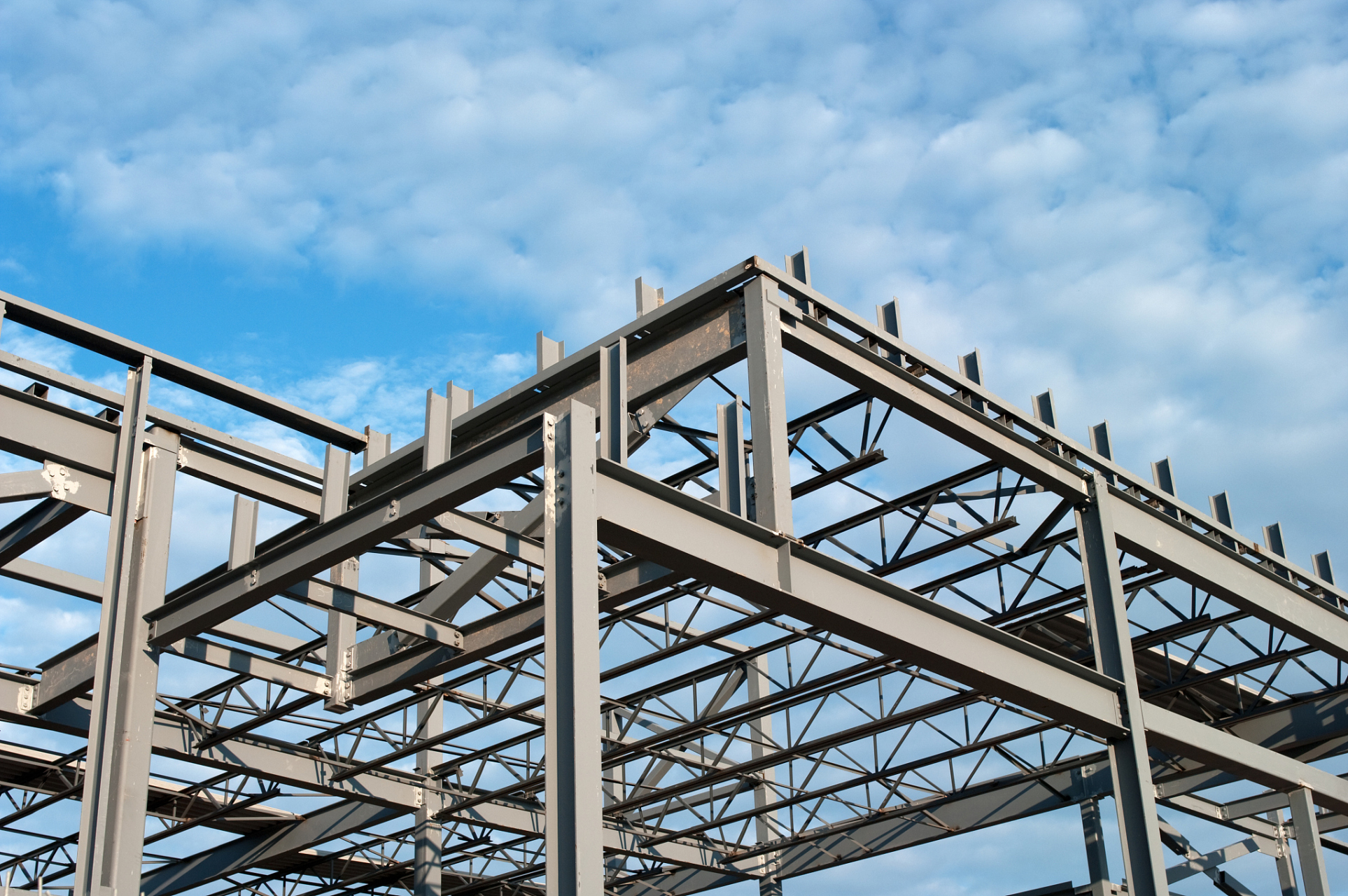
Cross-industry technology transfer enhances all remote site facilities. Warehouse storage solutions utilize identical thermal break technologies for temperature-sensitive supplies, while workshop areas incorporate vibration damping for equipment maintenance. Plant control rooms feature blast-resistant designs adapted from mining applications, and office container complexes utilize the same environmental controls as living quarters. This knowledge sharing accelerates innovation, as seen when offshore platform safety systems were adapted for remote mining camps handling explosives, demonstrating how Lida Group's expertise across sectors benefits all clients through shared engineering breakthroughs.
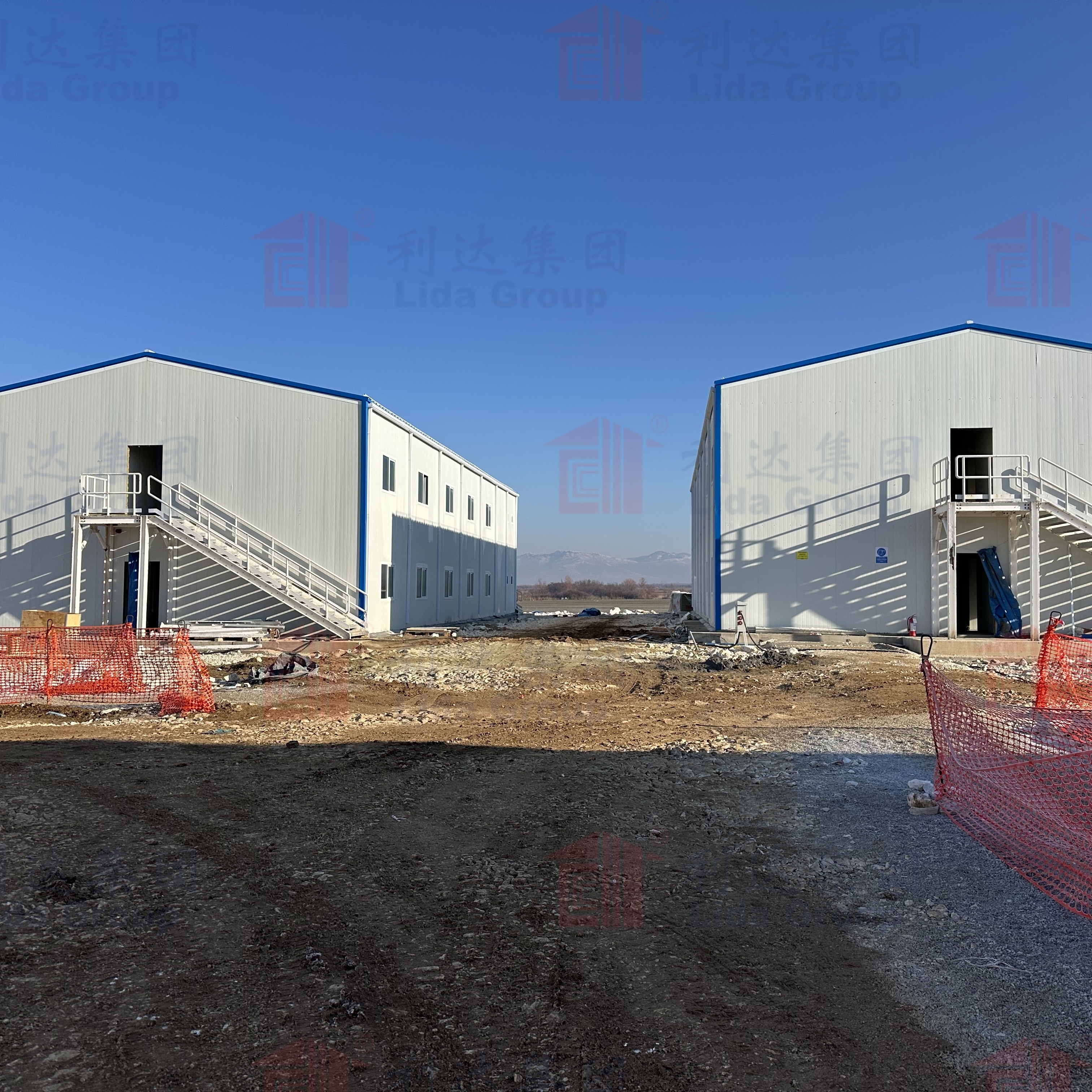
Sustainability integration occurs at multiple levels despite remote challenges. Solar-ready roofs feature pre-engineered attachment points and concealed conduits, while rainwater harvesting systems reduce water trucking requirements by 65%. Greywater recycling treats and reuses up to 85% of water consumed, critical in arid mining regions where water scarcity impacts operations. The bolted connection systems enable future disassembly and relocation, creating circular economies where traditional constructions would become disposable liabilities. When a decommissioned exploration camp was disassembled and rebuilt at a new site with 85% material reuse, the environmental benefits exceeded any temporary construction through permanent waste reduction.
Validation comes from extreme deployments across global projects. Prudhoe Bay camp house clusters maintained +21°C interiors during -54°C temperatures with 90km/h winds, while Siberian installations survived 150km/h ice storms without envelope compromise. Chilean mining camps withstood 8.8 magnitude earthquakes through base isolation technology, and Australian installations endured category 5 cyclones with wind-rated tie-down systems validated at 250km/h. Each case demonstrates how engineered solutions outperform conventional construction while delivering superior performance in the world's most challenging environments.
Lida Group's distinction as a premier steel structure supplier manifests in their technical rigor and remote site capabilities. Robotic welding achieves 0.15mm tolerances on critical connections, while coordinate measuring machines verify dimensional accuracy before shipment to inaccessible locations. Cryogenic testing subjects materials to -65°C before approval for Arctic service, and accelerated weathering chambers simulate decade-long exposure in months. Third-party validation includes ISO, API, and ASME certifications across 37 standards relevant to remote operations, ensuring clients receive structures proven to perform when failure is not an option.
Future innovations push boundaries further for remote site accommodations. Self-healing polymer coatings repair micro-abrasions from ice crystals without manual intervention, while variable-stiffness electrochromic windows dynamically modulate solar gain to reduce energy consumption. Hydrogen-compatible designs incorporate leak detection networks and explosion-ventilated mechanical rooms for future energy systems, and autonomous inspection drones conduct thermal envelope assessments during blizzards too severe for human crews. These advancements position camp house solutions not as temporary shelters but as evolving platforms that adapt to technological change and increasing environmental challenges.
When miners sleep soundly through -50°C blizzards and medical staff perform procedures in stable environments during Arctic storms, Lida Group's engineered habitats prove that remote operations needn't sacrifice safety for operational necessity. These solutions deliver measurable value: 74% fewer cold-related incidents through oxygen-enriched environments, 95% camp occupancy maintained during polar vortex events, 41% lower turnover versus conventional camps through circadian lighting systems, and 63% reduced generator fuel consumption through aerogel insulation. The true breakthrough lies not in surviving extreme environments but thriving within them – turning what was once the domain of temporary expeditions into permanent, productive communities through the marriage of engineering and endurance.
As resource exploration pushes deeper into Arctic regions and remote deserts to secure critical minerals, these light steel structure systems transform from temporary shelters into strategic assets that attract skilled talent, ensure operational continuity, and demonstrate that through material science mastery and manufacturing precision, even the most hostile environments become spaces where human ingenuity prevails. This operational reality positions Lida Group's engineered solutions not as construction alternatives but as essential components of successful remote operations worldwide, proving that with proper engineering, there are no longer inaccessible locations for industrial development and human achievement.
modular house,camp house,steel structure building,workshop,warehouse
Contact Us
Head Office: 5th Floor,Building A,Darron Center,No.180,Haier Road,Qingdao, 266000,China
Tel: 0086-532-88966982 88965892 Fax:0086-532-88965571
WhatsApp:+86 13793209022
Mobile/Wechat:+86-15166671720
Email: sales@lidajituan.com Website: www.lidajituan.com
Alternate Website: www.lidamodularhouse.com

Head Office: 5th Floor,Building A,Darron Center,No.180,Haier
Road,Qingdao, 266000,China
Tel: 0086-532-88966982 88965892
Fax:0086-532-88965571
Email: sales@lidajituan.com
Website: www.lidajituan.com
Wechat/WhatsApp:+86-13793209022
Copyright(c)2023 All Rights Reserved SEO Business license